Google launched Google for jobs at Google I/O a few months back, and they have now officially launched the Schema for developers and site owners to follow to help their job listings get pulled into Google’s new job Search Engine.
RECAP: What’s Google for Jobs?
Direct from Google: “For queries with clear intent like [head of catering jobs in nyc] or [entry level jobs in DC], we’ll show a job listings preview, and each job can expand to display comprehensive details about the listing:
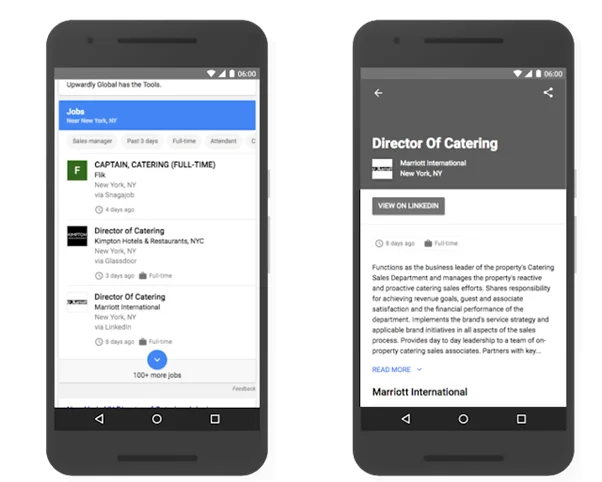
This is of course a powerful place to gain visibility, making it vital that your site is updated with this schema as soon as possible (if you list job posts on your site).
What’s a Schema?
A Schema is just a set of invisible tags which allow you to label your data so that it can be understood by a 3rd party, for example Google. Google will read signposts and use these to determine that a number on your job landing page is actually the salary range of the role, not a start date or part of the job name.
With all of your data signposted, Google will be able to quickly take all of the job role information, copy it and then post that job in their Google for Jobs results. Then, when a user searches for something relevant to that role, Google can show your result with a link back to the page on your site where the user can apply.
Why Do I Want Google to Have My Job Posts? Won’t They Steal My Traffic?
For most sites, they can only benefit. Google is a huge portal and the place most people start their online journeys when they have a specific task in mind to complete, like finding a job. So if you manage to get your roles listed in Google for Jobs, you’ll probably see a big increase in relevant traffic and people applying for your roles. Other bigger players like Indeed have more of a decision to make; Google’s long game is likely to cut these guys out as much as possible, or make them pay a significant cut for the traffic they once got for free.
Implementing the Schema
The guidelines for the schema are all here: https://developers.google.com/search/docs/data-types/job-postings Follow these closely, and ensure you test your implementation using the Structured Data testing Tool here: https://search.google.com/structured-data/testing-tool Even minor errors may mean your jobs are not pulled into results. Good luck!